By . Follow the discussion on computeraudiophile.com and head-fi.org
Intro
From the land of ice hockey, frozen wine, and decent beer, comes:
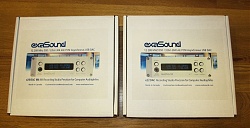
Two DACs manufactured by a small company in Canada called exaSound, run by a smart guy named George Klissarov. Both support PCM up to 32/384 and DSD up to DSD256 over USB. The e20 mkIII will run you $2499 and the e22 will run you $3499. exaSound also sells an 8-channel DAC called the e28, for $3849. See here for a spec comparison chart.
I bought the e20 first, and after deciding I liked it -- a lot -- I bought the e22. The e20 will serve office duty with my less-expensive audio equipment, while the e22 will remain at home with my nosebleed stuff. I should note that I did not compare them together at the same time. Since they can't both be connected via USB to a single computer simultaneously, it would be difficult to do quick A/B tests anyway. Also, my e20 is one of the lucky few that came with a free upgraded clock, so that would make any differences that much harder to hear. But my sonic memory is pretty good, and as I detail below, they both sound phenomenal.
Build Quality
The e22 is a few inches longer than the e20, but otherwise they are of identical dimensions. Both units are very light and compact, with an aluminium chassis, but they don't have the "audio jewellery" look. In other words, they look more at place next to your PC than next to a $50K amp. I do wish the units had something better than the small stick-on rubber feet they come with. I wanted more clearance on the bottom so I added these isolating rubber feet from Amazon.
The power supply on both units is external, but it's a very high-quality power brick, according to exaSound. If you worry about this, there are third-party companies that will sell you a custom AC/DC converter for $500 and up. I personally would be shocked if it made a difference.
The units do not get hot or even warm during operation, unlike many previous DACs I've owned. This applies both to the chassis and the power brick. A sign of proper engineering, IMHO.
Input/Output
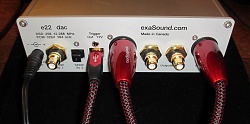
On the back the e22 has upgraded gold RCA outs, an upgraded gold coax SPDIF input, and a USB type B jack instead of the e20's USB mini jack. The e22 also has a 12V trigger output. Both have identical optical SPDIF inputs. The front display and buttons are the same, and everything seems solid. One slight annoyance is that the backlit area of the display is not centered in the front panel cutout in both units, something you can't see on the website pictures. While this seems very out-of-place to anyone even mildly OCD, it has zero bearing on functionality. However, I do implore exaSound to fix it:
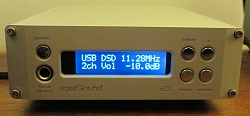
Remote control is supported with an included, ubiquitous Apple IR Remote, and works flawlessly to duplicate the functionality of the front buttons. That is, it can turn the unit on/off, change inputs, and change volume. Regarding volume... the e20's volume can be set anywhere from 0db to -80db. At 0db there is no attenuation at all and output should be bitperfect. Attenuation is implemented by asking the ESS Sabre chip, politely, to turn it down. George explains it here.
Software Quality
One of exaSound's competitive advantages is their proprietary ASIO drivers, which work with a custom FPGA buffering stage in the DAC. This serves to eliminate the PC and USB cable as possible sources of noise/jitter/errors. As a coder I know how hard writing software is, so I'm not surprised to see that only one dedicated audio company appears to have gone this extra mile. I use Windows 8.1, and the exaSound driver and control panel work flawlessly with JRiver:
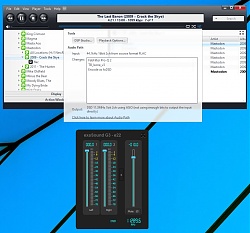
One thing to keep in mind is that the exaSound does not appear in the Windows control panel as an audio device... it's ASIO only, so you need a music player application that speaks ASIO. If you want "ordinary" computer sound to go through the e20/e22, connect the SPDIF output from your existing sound card to one of the unit's SPDIF inputs. Then you can simply switch to that input. I don't consider this a big limitation, as all high-end DACS require you to play music in ASIO/WASAPI exclusive mode for the best SQ. And exclusive mode already precludes other PC sound (like YouTube) from being heard at the same time.
Sound Quality
(Tested primarily with a Woo Audio WA22 headphone amp and a pair of Audeze LCD-XCs.)
The e20 and e22 are both phenomenal sounding DACs, and are built around the ESS's flagship ES9018 Sabre chipset. I've owned a bunch of ES9018-based DACs and am a big fan, although ESS does have its doubters (who like to call us "Sabre rattlers"). It's revealing, detailed, and neutral, and can produce good punch and bass when called upon. I think it makes a good companion to a tube amp, if that's your thing. Although I tested primarily with my WA22 through the balanced DAC outputs, I tried the DACs' headphone jacks as well, and found them to be excellent solid-state amps. The e22 headphone jack supposedly can provide twice the power of the e20's, but I never needed to drive it that hard.
I tested many genres of music with JRiver at all sorts of resolutions. 16/44, 24/96, 32/384, DSD64, DSD128, DSD256, both native and upsampled with JRiver. Sources come from my own CD FLAC rips, DVD-Audio rips, BluRay rips, and high-quality PCM and DSD downloads from various Internet vendors.
I'm not one for long, elaborate descriptions of tonality, soundstage, and "dark backgrounds". Suffice it to say these DACs bring out the best of the ES9018 without any hint of hardness or graininess. They basically just get out of the way and let the music speak for itself. Heck, they are good enough to scale right along with two of the most expensive heaphone amps and headphones on the market. The WA22/LCD-XC combo is lush but also mercilessly revealing of bad -- and good -- recordings. There is no way anything short of a world-class DAC can bring out its best, and the exaSounds do.
Also, keep in mind exaSound pioneered DSD256 support, and continues to specialize in excellent DSD playback quality. All of my native DSD tracks sounded spectacular, as did PCM converted to DSD via JRiver. (However, I'm not ready to say that PCM->DSD improved the SQ. Just that it didn't degrade it, which is not something I can say about previous DACs I've owned.)
There was no trace of noise, USB or otherwise, through these DACs. As I mentioned before, there are occasionally some medium-volume clicks when stopping/starting playback at very high resolutions, but this is not bothersome (and is an ES9018 limitation according to George). There were no clicks, pops, skips, or static in any other circumstances.
Summary
Is either the e20 or the e22 for you? I personally think they are the best computer audiophile DACs on the market. That is, if your preferred music source is Redbook or better audio from your PC, then you cannot theoretically do better than exaSound. Especially if you are a fan of DSD tracks, since for many competing USB DACs, proper DSD support is an afterthought. (Hint: if a competing DAC only does DSD over DoP, you know DSD was an afterthought.)
Is the e22 worth $1000 more than the e20? Although I didn't AB them side-by-side, I'm confident any SQ difference is minimal. But there are solid engineering improvements in the e22, like a better clock, beefier headphone output, a 12v trigger, gold connectors, and so on. I would say go for the e22 if you can swing it.
Who should NOT buy the e20/e22? Well, I suppose if you need a DAC that looks like an exotic alien sculpture or a Ferrari, to match your $100k stack of amps made by Swiss elves. Also, if you need more choices regarding inputs/output, you may want something from a pro audio company. And maybe you're allergic to the ESS Sabre, or have a religious aversion to anything less than a fully custom FPGA DAC, such as those offered by Chord Electronics or PS Audio. But in my experience those don't sound any better!
Also, don't be afraid of buying these units direct from Canada. The shipping process was absolutely painless with Fedex. For me, it only took a couple days for exaSound to ship each DAC (presumably for final assembly or burn-in), and then precisely two days for Fedex to deliver it. And they offer a generous 30-day return policy as well, and respond quickly to emails.